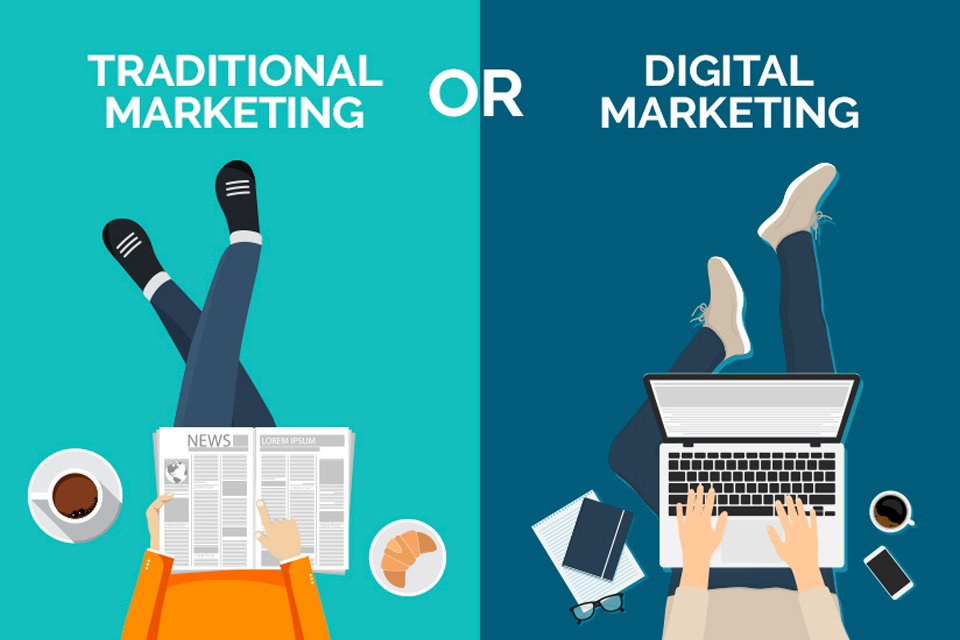
Understanding traditional marketing vs digital marketing is the single most important step in choosing how to grow your business today.
Quick Summary
The main difference in traditional marketing vs digital marketing comes down to the channels used to reach an audience. Traditional marketing relies on offline media like television, radio, print ads, and billboards to build broad brand awareness. Digital marketing uses online channels like search engines, social media platforms, websites, and email to target specific audiences, track real-time results, and generate lower-cost leads.
Key Takeaways
- Traditional channels use offline media like print, radio, TV, and direct mail to reach large local audiences.
- Digital strategy relies on online platforms like Google, Facebook, Instagram, and email to connect with hyper-targeted groups.
- Online strategies allow you to track every click, view, and purchase with real-time analytics data.
- Offline media usually requires larger upfront investments with fixed ad placements and long production timelines.
- Most modern businesses achieve the best return on investment by combining online and offline tactics into one cohesive strategy.
What is Traditional Marketing?
Traditional marketing refers to any promotional strategy that uses offline channels to reach potential customers. It includes physical print materials, broadcast media, outdoor displays, and direct physical outreach. For decades, this was the only way for businesses to build brand recognition and attract sales.
Core Channels of Traditional Promotion
- Broadcast Media: Television networks and radio stations deliver ads to broad local or national audiences.
- Print Media: Newspapers, magazines, flyers, and brochures display visual advertisements directly to readers.
- Outdoor Advertising: Billboards, transit stops, and stadium banners capture attention from commuters and passers-by.
- Direct Mail: Catalogues, postcards, and sales letters arrive directly in physical mailboxes.
- Telemarketing: Cold phone calls and automated voice messages reach consumers at home or work.
How Offline Promotion Works
Offline campaigns focus on high-frequency broadcasting. You pay a fee to place your message in front of an existing audience controlled by a publisher or media network. A local hardware store might purchase a spot on a morning radio show, or a law firm might rent a billboard along a major highway. The goal is to maximize exposure so that buyers remember your name when they need your product.
What is Digital Marketing?
Digital marketing encompasses every promotional effort that occurs online or on an electronic device. Instead of broadcasting to everyone, online strategies use data to connect with people actively searching for specific solutions or demonstrating specific online behaviours.
Core Channels of Online Growth
- Search Engine Optimization (SEO): Optimizing website content so your business ranks high on Google search results.
- Pay-Per-Click Advertising (PPC): Running target ads on Google, Bing, or YouTube where you only pay when someone clicks.
- Social Media Management: Creating content and ads on platforms like Facebook, Instagram, LinkedIn, and TikTok.
- Content Creation: Publishing blog posts, articles, videos, and ebooks that answer customer questions and build trust.
- Email Marketing: Sending personalized newsletter updates, promotional offers, and automated follow-ups to subscriber lists.
How Online Promotion Works
Digital strategy relies on user intent and precise data tracking. When a consumer types a search term into Google, the search engine displays relevant text ads and organic web pages. When a user browses social media, algorithms show ads based on their exact interests, job title, or buying history. This two-way communication makes online promotion fast, measurable, and highly adaptable.
Traditional Marketing vs Digital Marketing: Core Differences
Comparing traditional marketing vs digital marketing highlights how modern tools have changed business promotion. Understanding these core differences helps owners invest their capital where it yields the highest return.
Audience Targeting Capabilities
Offline promotion relies on broad demographic coverage. A newspaper ad reaches everyone who buys the paper, regardless of whether they need your service. An online ad lets you select exact target traits. You can show an ad only to homeowners aged 30 to 45 living in specific zip codes who searched for roof repair within the last 48 hours.
Cost and Budget Flexibility
Traditional outlets demand significant upfront cash commitments. Printing ten thousand flyers or buying a broadcast slot costs thousands of dollars before a single customer contacts you. Online campaigns let you start with micro budgets as small as five dollars per day. You can scale spending upward as you confirm which ads generate profitable sales.
Speed of Execution and Campaign Changes
Once a magazine ad goes to press or a billboard is installed, you cannot change the message. If you notice a typo or want to update a sale price, you must pay for a completely new campaign run. Online promotion offers real-time adjustments. You can change ad copy, swap image graphics, or pause failing campaigns instantly with a single button click.
Result Tracking and Analytics
Measuring offline success requires estimation. You might count how many paper coupons customers bring to your store, but you cannot determine exactly how many people saw your billboard before driving over. Online tools track the exact path of every visitor. You see which ad they clicked, which pages they read, how long they stayed, and whether they completed a purchase.
Pros and Cons of Traditional Outlets
Offline media still offers unique value, but it comes with distinct drawbacks that business owners must weigh carefully.
Advantages of Offline Channels
- High Local Exposure: A billboard on a busy highway guarantees thousands of daily views from local residents.
- Physical Presence: Printed materials like brochures and business cards give prospects something tangible to hold and store.
- Immediate Local Familiarity: Older demographics often place higher initial trust in established local radio stations and print newspapers.
Disadvantages of Offline Channels
- High Total Cost: Small businesses struggle to compete because big brands buy up prime TV slots and ad spaces.
- Difficult Measurement: You cannot easily tell which ad prompted a client to visit your physical storefront.
- Static Messages: You cannot tweak your messaging without incurring extra printing or production fees.
Pros and Cons of Digital Outlets
Online platforms provide unprecedented control, though managing constant updates requires technical knowledge and strategic oversight.
Advantages of Online Channels
- Hyper-Targeted Campaigns: Reach exact buyer profiles based on interests, active searches, location, and purchase history.
- Full Cost Control: Adjust your daily spending limit and stop campaigns whenever performance drops below targets.
- Global or Local Reach: Expand your client base across the country or focus entirely on neighbourhood search traffic.
- Measurable ROI: Track every dollar spent to calculate exact customer acquisition costs and net profit rates.
Disadvantages of Online Channels
- High Online Competition: Thousands of rival businesses compete for the exact same search keywords and social ad spaces.
- Constant Platform Changes: Search engine algorithm updates and ad platform rule changes require continuous learning.
- Ad Fatigue and Blockers: Users often scroll past online ads or install browser extensions to block promotional banners.
Traditional Marketing vs Digital Marketing Strategies
As online ecosystems evolve, strategy shifts from basic web presence to hyper-personalized experiences. Comparing traditional vs modern digital marketing strategies reveals how top brands stay ahead of consumer expectations.
Traditional Marketing vs Digital Marketing: Key Differences
| Aspect | Traditional Marketing | Digital Marketing |
|---|---|---|
| Medium | TV, radio, print, billboards, flyers | Websites, social media, email, search engines |
| Reach | Local/regional, broad but untargeted | Global, highly targeted |
| Cost | Generally higher upfront investment | Flexible, scalable budgets |
| Targeting | Mass audience, limited segmentation | Precise targeting (age, interest, location, behavior) |
| Measurability | Hard to track results accurately | Real-time analytics and detailed tracking |
| Engagement | One-way communication | Two-way, interactive engagement |
| Speed | Slower to launch and change | Quick to launch, edit, or pause |
| Longevity | Physical materials can last (print, billboards) | Content can be updated or removed anytime |
| Trust factor | Often seen as more credible/established | Building trust takes consistent effort |
Old Traditional Marketing vs Digital Marketing Online Growth
Early online strategies focused on broad display banners, high-volume keyword stuffing, and mass email blasts to rented lists. Modern strategies focus on user intent, high-value content, automated customer journeys, and multi-channel marketing funnels. Modern online tools build ongoing relationships rather than pushing high-friction sales messages.
The Role of Artificial Intelligence and Automation
Modern online marketing heavily integrates artificial intelligence. Smart algorithms analyze search patterns, write preliminary ad drafts, segment audience lists, and optimize bidding strategies in real time. Automation tools nurture leads by sending targeted emails right when a potential customer takes a key action on your site.
The Shift to Mobile-First and Search Intent
With over half of global web traffic originating on smartphones, modern strategies prioritize mobile design and voice search compatibility. Search engines evaluate how quickly pages load on mobile devices and how effectively content answers specific search queries. Modern marketers optimize for direct user intent rather than simple search phrase matching.
Choosing the Right Mix for Your Business
Deciding between traditional marketing vs digital marketing isn’t always an either-or choice. The best promotional strategy depends on your business model, target market, overall budget, and growth timeline.
When to Prioritize Offline Media
- You serve a localized, older demographic that spends limited time on internet platforms.
- You operate a high-volume local service business where billboard and radio reach builds brand recall.
- You sponsor major regional events, trade shows, or community gatherings to build face-to-face relationships.
When to Prioritize Online Channels
- You sell products through an e-commerce website to buyers nationwide or globally.
- You run a local service firm that wants to capture customers searching for immediate help on Google.
- You operate on a tight startup budget that requires strict tracking of every promotional dollar.
- You need fast customer feedback to refine your offers and message strategy.
Building a Hybrid Marketing Strategy
Combining offline and online media often produces superior results compared to using either approach in isolation. A local restaurant might run direct mail post cards featuring a special QR code. Scanning the code sends customers to a landing page where they join an email club in exchange for a free appetizer. This hybrid model uses offline reach to build an valuable online customer list.
How to Transition from Offline to Online Channels
Shifting your business budget from offline ads to digital channels requires a structured process to avoid wasted capital and lost momentum.
Step 1: Audit Your Current Results
Examine your existing offline efforts. Determine which channels bring in identifiable leads and calculate your current customer acquisition costs. Identify low-performing traditional ads that can be safely paused to free up test budget.
Step 2: Establish Your Online Foundations
Build a fast, mobile-friendly website that clearly presents your core offer. Set up essential tracking tools like Google Analytics 4 and Google Search Console. Claim and optimize your Google Business Profile to capture local search volume immediately.
Start small with search ads that capture active buyers. Run Google Search Ads on high-intent keywords where prospects actively search for your service. Add social media ad retargeting to stay visible to visitors who left your website without making a purchase.
Step 4: Analyse Real Data and Scale Success
Review your analytics weekly. Look at metrics like click-through rates, cost per lead, and overall conversion rates. Double down on keywords and ad creatives that generate profitable sales, while turning off campaigns that perform poorly.
FOR DIGITAL MARKETING
Partner with Likith Kumar, recognized as the best AI digital marketing expert in Tirupati for cutting-edge online growth strategies. Contact in Instagram by Likith Kumar
Direct Expert Access: Work straight with Likith Kumar—no agency middlemen or communication delays.
AI-Powered Precision: Lower your acquisition costs and maximize ad ROI using cutting-edge marketing technology.
Proven Local & Global Strategies: Dominate local Tirupati searches while scaling your reach effortlessly.
Conclusion
In the ongoing traditional marketing vs digital marketing debate, digital marketing is generally more cost-effective, measurable, and adaptable for modern audiences. But traditional marketing still holds value for building brand trust and reaching offline audiences. Ultimately, the best strategy depends on your business goals, target audience, and budget. Understanding the strengths of both traditional marketing vs digital marketing methods will help you build a smarter, more balanced marketing plan for the future.
FAQs
What is the main difference in traditional marketing vs digital marketing?
The main difference lies in the channels used. Traditional marketing uses offline channels like print, radio, TV, and billboards, while digital marketing uses online channels like search engines, social media, websites, and email to reach audiences.
Is traditional marketing still effective today?
Yes, traditional marketing remains effective for reaching broad local audiences, targeting older demographics, and establishing brand recognition through tangible media like direct mail, local radio, and billboards.
Why is digital marketing usually cheaper than traditional marketing?
Digital marketing allows businesses to set small daily budgets, target specific intent, and pay only for actual interactions like clicks or views. Traditional marketing requires higher upfront payments for physical materials, printing, and broadcast airtime.
Which is better for a small business traditional marketing vs digital marketing?
Digital marketing is generally better for small businesses because it offers lower startup costs, precise audience targeting, fast implementation, and measurable results that show your exact return on investment.
Can a business use both traditional marketing and digital marketing together?
Yes, combining both methods into a hybrid strategy often works best. For example, placing QR codes on print flyers or billboards drives physical foot traffic to digital landing pages and email sign-up forms.
How do you measure return on investment in digital marketing?
You measure return on investment in digital marketing by using software tools like Google Analytics to track user actions. These tools show exact click counts, lead form submissions, online sales, and cost per acquisition metrics in real time.
What are the four main types of digital marketing?
The four primary types of digital marketing are Search Engine Optimization (SEO), Pay-Per-Click Advertising (PPC), Social Media Marketing, and Content Marketing.
Does digital marketing work faster than traditional marketing?
Paid digital marketing strategies like Google Ads or Facebook Ads deliver immediate web traffic and leads within hours. However, organic digital strategies like SEO take three to six months to build momentum, similar to long-term traditional campaigns.
How does targeting work in digital marketing vs traditional marketing?
Digital marketing targets users using specific data points like age, location, interest categories, search terms, and buying behaviors. Traditional marketing targets broader groups based on general broadcast regions or media readership profiles.
Will digital marketing completely replace traditional marketing in the future?
Digital marketing will not completely replace traditional marketing. While online ad spending continues to grow faster, offline media will keep its value for local brand awareness, event sponsorships, and tangible physical customer touchpoints.